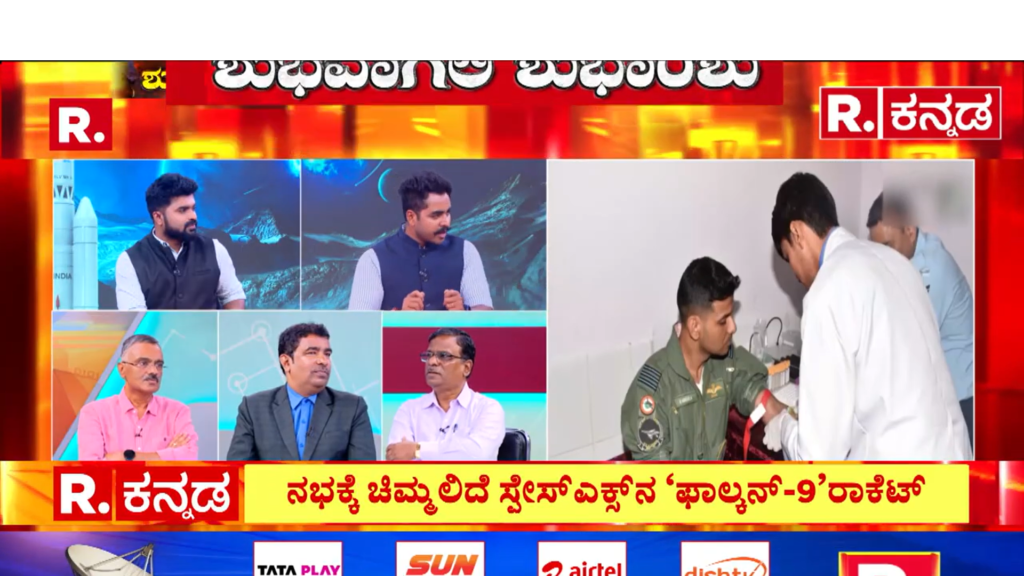
Krishnamurthy Manjunatha Invited by Republic Kannada Channel to Discuss Axiom-4 Mission to the International Space Station
The launch of the Axiom-4 mission to the International Space Station marked an important moment in modern human spaceflight and created great excitement among space enthusiasts across India. To help viewers understand the mission in detail, Krishnamurthy Manjunatha was invited by Republic Kannada for a special live discussion on the Axiom-4 mission to the International Space Station. The event was live telecast on Republic Kannada, where he explained the complete mission journey—from launch to docking—in a simple and practical way for the general public.
During the discussion, Krishnamurthy Manjunatha explained the role of the Falcon 9 rocket, one of the most reliable reusable launch vehicles used for human spaceflight today. He described how Falcon 9 carries the crewed SpaceX Dragon spacecraft into orbit using its powerful first and second stages. The first stage provides the initial thrust required to escape Earth’s gravity and then returns for landing and reuse, while the second stage continues pushing the Dragon capsule into the correct orbital path toward the space station. This reusable launch system represents a major advancement in reducing the cost of human space missions.
He also explained the Dragon spacecraft and crew capsule in detail, highlighting how it serves as both the transportation system and temporary orbital home for astronauts during the mission. The capsule is equipped with life-support systems, navigation controls, docking mechanisms, communication systems, and emergency safety systems to ensure crew survival and mission success. He described how the astronauts remain inside the capsule for the journey to orbit and how the spacecraft performs multiple orbital maneuvers before reaching the station.
One of the most interesting parts of the discussion focused on a common public question—why does it take so much time to reach the International Space Station when the rocket launch itself happens in just a few minutes? Krishnamurthy Manjunatha explained that reaching the ISS is not simply about going upward; it is about achieving the correct orbit and matching the exact speed, position, and trajectory of the space station, which is moving around Earth at nearly 28,000 kilometers per hour. The Dragon capsule must carefully perform orbital corrections and gradually align itself with the station before docking. This process takes several hours and sometimes longer depending on mission planning, safety protocols, and orbital conditions.
He further explained that docking with the ISS is one of the most precise operations in human spaceflight. The spacecraft must approach slowly using advanced sensors, automated navigation systems, and multiple safety checks before final docking is completed. Even a small error in speed or alignment can affect the mission, which is why the process is intentionally slow and carefully monitored.
This Axiom-4 mission is especially significant because it represents a new era of private human spaceflight missions working in collaboration with international space agencies such as NASA. It also inspires Indian students and young professionals by showing how global partnerships and commercial space missions are shaping the future of exploration beyond Earth. Such missions are not only scientific achievements but also educational milestones that help society better understand the complexity of human space travel.
Through the live Republic Kannada discussion, Krishnamurthy Manjunatha successfully translated highly technical aerospace engineering concepts into simple and engaging explanations for viewers across Karnataka. His detailed insights into Falcon 9, the Dragon spacecraft, orbital travel, and ISS docking helped students, parents, and space enthusiasts appreciate the extraordinary engineering behind human space missions.
This appearance reflects the larger mission of iMars Organization and Krishnamurthy Manjunatha—to promote practical space education, public scientific awareness, and inspiration for the next generation of scientists, engineers, and astronauts. By making space science understandable to everyone, such discussions help build India’s future space workforce and encourage young minds to dream beyond Earth.